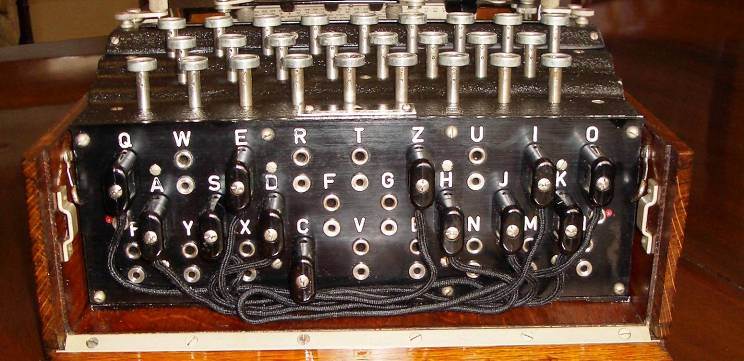
The Enigma cipher machine was invented by a German engineer, Arthur Scherbius, who applied for his patent on February 23, 1918. This
was in the same time frame that 3 other inventors from 3 other countries also applied for a patent for a rotary cipher machine. Scherbius
first tried to sell his design to the German military but finding no interest decided to start up his own company to manufacture the Enigma
for commercial sale.
The Enigma machine was first offered for sale in 1923, but had few takers. The first model A and model B machines were heavy at 110 lbs.
and also cumbersome to use. These first models had a typewriter incorporated into the device but did not have a reflector.
The model C came out in 1925, which was much smaller and lighter and included the reflector. The typewriter was replaced by a lamp panel,
requiring the user to write down the results of ciphering and deciphering a message. The model D was unveiled in 1927, and it was this
model that saw commercial interest from many countries.
The German Navy adopted the Enigma in 1926 and the Army in 1928. Both services modified the Enigma for their purposes, and would continue
to modify their Enigmas and keep them different through the end of WW2. They both added the plugboard, which swaps letters in pairs before
and after the signal goes to the rotors, adding a significant cryptologic strength to the Enigma. By this time the weight of the Army
Enigma was 26 lbs., much lighter than the original machines but still heavy for a battlefield cipher. This was a much stronger cipher than
the US M-209 but the US cipher machine weighed only 6 lbs., did not require batteries and had a printer so it could be operated by one person.
The Enigma machine was an ingenious advance in technology, both for the strength of the encipherment and for the ease of use for the
operator. It is an electro-mechanical machine resembling a typewriter, with a plugboard to swap letters, rotors to further scramble the
alphabet and a lamp panel to display the result. Most models of Enigma used 3 or 4 rotors with a reflector to allow the same settings to
be used for enciphering and deciphering.
Most of the description which follows will be for the Army 3 rotor machine, which you can see in pictures from my collection. The key was
made up of 3 settings: the set of letters to be swapped in the plugboard, the order of the 3 rotors from the available set of 5 and finally
the A to Z letter setting for each rotor. The theoretical key space is 3 X 10114, which is far larger than the number of atoms
in the universe. Even as used by the Nazis, the key space was 1023, which means 100,000 operators, each checking one key setting
every second would take twice the age of the universe to break the code. Despite these overwhelming odds, the Allies did just that.
Each component will be described in turn as the electrical connection goes from the keyboard, through the plugboard, through the rotors and
back to the plugboard before finally lighting up a light bulb on the lamp board.
QWERTZUI Keyboard
The keyboard has a QWERTZUI layout, without any numbers, space bar or any other keys. Pressing a key will electrically open a signal
from the letter pressed and will also mechanically advance from 1 to 3 rotors. Touch typing does not work because of the pressure required to
advance the rotors and since there is no printer and the letter lit up has to be written down. Each letter will be enciphered from 7 to 9
times and because of the design of the reflector, no letter will encrypt to itself. Note also the data plate under the "V".
Plugboard
The layout of the plugboard matches the QWERTZUI layout of the keyboard, which is also the layout for the lamp panel. Plugboard cables
use plugs which look like the standard 2-prong European power plugs. The Nazis always used 10 cables, swapping 20 letters for their daily key.
While using a variable number of cables would provide a stronger cipher, the tradeoff would be a greater possibility of errors. Interestingly,
using more cables gives a stronger cipher up to 11, then perhaps counterintuitively, the strength of the cipher declines dramatically. You can
follow this logic mathematically in the section below,
Calculation of Key Space.
Reflector (on left with red "B") with 3 rotors, view of one rotor on spindle
After the electrical signal leaves the plugboard, it goes to an entry wheel, the 3 rotors, the reflector, then reverses course back
through the 3 rotors, the entry wheel, the plugboard and then lights up a light under one of the 26 characters. The British worked hard
to figure out the encipherment used for the entry wheel, only to be told by the Polish codebreakers there was no encipherment for that wheel.
Each character is therefore enciphered by each wheel twice and by the reflector, giving 7 separate encipherments. The plugboard may or may
not encipher a character, so the final result is that after going through the plugboard twice each character can be enciphered between 7
and 9 times.
There are 3 rotors in the machine, from a selection of 5 available. Each rotor has the numbers 01 through 26 on its circumference,
representing the letters of the alphabet. The daily key is a choice of the 3 out of 5 rotors, their order on the spindle and the rotational
setting of 01 to 26 for each rotor.
Also, each rotor has a setting for the location to cause the wheel on
its left to advance. The rotors advance "odometer style", the rightmost rotor advances after each letter enciphered, at some setting on
that rotor it causes the middle rotor to advance, which would then happen every 26 letters. The leftmost rotor advances at some setting
of the middle rotor and then advances every 26 rotations of the middle rotor. This gives a message depth of 26 X 26 X 26 = 17,576, which
means that after that many characters of a message are enciphered, the encipherment repeats. The notch causes the turnover to occur 8
characters before the location of the notch. For example, the rotor above has a notch in position "D", so the wheel to its left would
advance after moving past position "V". The notch on the leftmost rotor has no effect.
The Nazis did not change the position of the notch and each wheel had the notch on a different letter. The Allies were able to exploit this
fact, since this made each wheel unique. Also, the regular, odometer style stepping of the rotors was a major security flaw, because only
one wheel would change and all other positions would remain the same for 26 consecutive characters. By comparison, the US Sigaba and the
Swiss NEMA cipher machines were specifically designed to provide irregular stepping of the rotors.
The reflector simply swaps each letter in pairs so the same setting can be used for enciphering or deciphering. The reflector was fixed
in the Enigma, so this setting was known to the Allied cryptographers after capturing the first Enigma. Also, this reciprocal design means
that no letter enciphers to itself, which is another cryptologic shortcoming exploited by the Allies. The 4 wheel Naval Enigma used a
reflector that was movable, so it could be set to 26 different positions. Also, there were 2 reflector wheels to select from, greatly
increasing the complexity of the Naval Enigma.
Lampboard
The lampboard follows the same layout as the keyboard and plugboard. Each letter has a light bulb under it, which lights up to show the
enciphered or deciphered letter, which must then be written down. There is a filter attached inside the lid which can be installed over the
lampboard to reduce the amount of light emitted from the Enigma. When operating the Enigma at night close to enemy lines, the filter keeps
the operator from being easily spotted.
The light bulbs are powered by a 4.5 volt battery or a transformer plugged into a 220 volt outlet. The lampboard is the only output, so
the Enigma machine usually required 2 operators, one to operate the keyboard and the other to write down the message.
The Enigma wiring diagram below shows an example of an "A" being pressed on the keyboard and the path of the encipherment is
highlighted until the "H" lights up on the lampboard. The "A" is first enciphered to an "O" on the plugboard, then goes to the
rotor assembly. The "O" will be enciphered 3 times going through the 3 rotors, once more going through the reflector and 3 more
times going through the 3 rotors in reverse. At this point the letter coming into the plugboard is an "M" which gets enciphered
into an "H", which causes the "H" bulb to light up on the lampboard.
In this example, the "A" was enciphered 9 times, which is the maximum number any letter can be enciphered. Since 20 of 26
letters are swapped in the plugboard, it is possible that one or both encipherments on the plugboard could be skipped, yielding
a total of 7 or 8 encipherments for some letters.
Wiring Diagram - the "A" key is pressed, causing 9 encipherments, then the "H" lights up.
You can play this animation to follow the electrical charge as it advances through the Enigma.
To use the Enigma machine, the user must change the settings to the daily key. This involves installing the 3 rotors from the 5 available
in the correct order. Then he would plug in the 10 plugboard cables, connecting the 10 pairs of letters as specified in the daily setting.
Lastly, he would rotate the 3 rotors to the prescribed setting. All these daily settings would be sent to him in a code book sent once a
month, longer on boats and submarines.
Using Enigma in the field
Now, the user will select a 3 letter code of his choosing and encipher that code twice. Then he would reset the rotors to this new 3 letter
code and encipher the message he wants to send. Some users used the same 3 letter code repeatedly, for instance their girlfriend's initials
or the consecutive or diagonal letters on the keyboard, such as "WER" or "QAY". This was a violation of Nazi procedures which the Allies
were able to exploit to break the code on many occasions.
To decipher a message, he would reset the rotors to the daily setting and decode the
first 6 characters of the message. It should be a 3 character code, repeated, for example "BTLBTL". Now he would reset the rotors to "BTL"
and key in the rest of the message, writing down the letter lit up with each key stroke. The result will be the plaintext message. In
the field, the Nazis normally had one person keying in the letters and someone else writing down the message. There may even be a third
person to carry the plaintext message to the intended recipient or the enciphered message to a radio operator. Later in the war, the
3 character code was sent only once instead of twice, eliminating an easy method of Allied codebreaking.
The strength of the Enigma cipher gave the Nazis complete confidence in the security of their messages. Even when faced with clear
evidence that the Enigma messages were compromised, they steadfastly refused to believe it and instead attributed any security breach to
spies or coincidence. While the design was very strong, there were design and operational choices the Nazis made that weakened the
encipherment. For instance, the fact that no character could encipher to itself, always using 10 plugboard cables, enciphering the
3 letter message setting twice, etc. all helped the Allies break the Enigma code.
Marian Rejewski
Breaking the Enigma - The Story
The German Navy and Army adopted the Enigma in 1926 and 1928 but only added the plugboard in 1930. The Polish were understandably
nervous about German aggression and on September 1, 1932 the Polish Cipher Bureau hired a 27-year-old Polish mathematician, Marian Rejewski,
along with two fellow Poznan University mathematics graduates, Henryk Zygalski and Jerzy Rózycki, to try to break the code of this
new machine. This was an early insight into the role of mathematics in codebreaking.
The 3 Polish codebreakers had access to a commercial Enigma machine, without the plugboard, but did not know the rotor or reflector wiring. Through
a German spy, the French gained access to two months of Enigma key settings, but without the rotors were not able to make use of
this information. They passed along this information to their British and Polish colleagues and the Polish were able to quickly solve the
Enigma puzzle, recreating the wiring of the reflector, entry rotor, and the 3 rotors then in use. This was in December of 1932, and they continued
to break the code until the Nazis invaded Poland on September 1, 1939, marking the start of WW2.
Panzer General Heinz Guderian on communications truck with Enigma machine
The Polish not only broke the code, but invented the first electro-mechanical deciphering machine to systematically break the Enigma code.
They invented this device in the fall of 1938 and called their invention the "bombe". There is a debate
over whether this was named for the ice cream treat they were eating at the time of the idea or whether the ticking sound of the working
bombe sounded like an incoming Nazi bomb. The bombe consisted of 6 Enigma machines in series, so that all 6 possible rotor settings could
be tested at once. Using the bombe, the Poles were able to determine the Enigma rotor settings and decipher the first daily Nazi messages
within two hours, and in real time for the rest of the day. Unfortunately, when the invasion of Poland began, the Nazis added 2 new rotors,
increasing the possible combination of rotors from 6 to 60 (5 X 4 X 3). This made the Polish bombe ineffective, with the battle of wits
tilting back in favor of the Nazi codemakers.
The bombe and the secret of their codebreaking success was a closely guarded secret by the Poles until a month before the Nazi invasion.
In a conference near Warsaw, on July 26, 1939, the Polish codebreakers finally told their story of almost 7 years of codebreaking success to
the astonished British and French codebreakers. They knew of the impending Nazi invasion of Poland and gave their allies copies of the Nazi
Enigma with the plugboard and information on the bombe and Nazi operational procedures. Without this head start, the British effort to break
the Enigma would have been greatly delayed.
Bletchley Park - headquarters for British codebreaking
Alan Turing
After the outbreak of WW2 and the information from the Poles, the British codebreaking efforts began in earnest. They used an estate
north of London, Bletchley Park, as their headquarters. There would eventually be over 11,000 people working in secret on this codebreaking
effort. The British mathematician, Alan Turing, would lead the effort. Using the Polish experience in bombe making, they developed a bombe
with 36 Enigmas in series, with the first one delivered in May 1940. This would not test all combination of rotors, and a brute force attack
would take too long, in any case. Several contributions were made by Turing and others to eliminate many impossible rotor settings to allow
the 36 Enigma bombe to figure out the rotor settings in a reasonable amount of time.
Nazi U-boat in WW2
The British were routinely breaking the Nazi Air Force Enigma messages by May 1940 through the end of the war, mainly due to sloppy
operating procedures and consistent cribs. The Army and Navy versions took longer to solve, but were solved intermittently as changes were
made to each service procedures and Enigmas. The greatest challenge was the Naval Enigma, with its 4 rotors out of 8 available and the
strict operational procedures they practiced.
Before the US entered the war, the Nazi U-boats were the greatest threat to Britain. They were dependent on supplies from the US and the
Nazis were sinking on average 60 ships per month. Ships were sent over in convoys and the Nazis employed a strategy of "wolfpacks" to wait
until a dozen or so U-boats were on hand to swarm the convoy. This strategy was so efficient, Winston Churchill was later quoted as saying,
"The only thing that ever really frightened me during the war was the U-boat peril". The Nazi strategy was to completely blockade Britain
and win a quick victory over all of Europe before the US would enter the war.
The first time the British were able to decipher the Naval Enigma traffic was due to the capture of enemy code books from the U-110 in May of
1941. The captain, Fritz Julius Lemp, died trying to scuttle his submarine. The HMS Bulldog was towing the U-boat back to England when it
was ordered to sink it in the Atlantic so the Germans would not suspect the intact Enigma machine and codebooks were captured.
Captain Fritz Julius Lemp, sinking of U-110, Enigma operator inside U-110
HMS Bulldog captured the U-110 Nazi U-boat
After the breakthrough from the capture of the U-110 codebooks, the British found other creative ways to get later codebooks. They
discovered that the lightly armed weather ships had Enigma machines on them and the British would stage the capture of one of these weather
ships in such a way that the Germans thought they were chance happenings and the ship sank with its cryptographic treasures. They also were
able to get the codebooks from a few other U-boats, the most famous and courageous was the boarding of the already sinking U-559. Valuable
codebooks were captured, but 2 British sailors lost their lives as the U-boat sank.
Sinking of U-117 - August 1943
The British were zealous in protecting the source of their Enigma secrets. They were also careful to make sure that any actions taken from
Enigma messages had a "cover story" that would keep the Nazis from changing their machines or procedures. For instance, if the British knew
that two U-boats would surface in the mid-Atlantic at a specific location for refueling, they would have a spotter plane "accidentally" find
them and then have a ship nearby to sink the submarines before they could disengage and dive.
As a result of the Allies success in decrypting Enigma traffic, they were able to turn around the earlier Nazi rout in the Battle of the
Atlantic. The Nazi U-boat menace turned into a disaster with 725 of 1155 U-boats and 82% of 35,000 sailors never to return from sea.
One incredible side note to the Enigma story is the level of secrecy maintained for decades after WW2. About 11,000 people in
Bletchley Park and 4,000 in the US worked on deciphering Enigma traffic. Despite this widespread knowledge, the secret was not disclosed
until the UK government publicly acknowledged this secret in 1974, almost 30 years after the war was over. Some claim the Allied
cryptologic success shortened the war by 2 years, others placed even higher value on this success. As Winston Churchill told King George
VI, "It was thanks to Ultra that we won the war."
The non-plugboard version was known as the commercial Enigma, and was the version given to the German Allies, the Italians and Japanese. William
Friedman of the US was able to break this version in the 1920s by exploiting the “odometer-style” movement of the rotors. He also broke the earlier
US invention of the electric rotor cipher called the Hebern machine, which had 5 rotors and the same odometer-style movement.
Friedman went on to develop a more complex device that had 10 rotors, with another 5 to make the 10 rotors move irregularly. This was the SIGABA
and was never broken by the Germans or anyone else.
The military Enigma has a 76 bit key space, meaning that it has 2 raised to the 76th power of different possible key settings. This is the key
space AFTER assuming you capture one of these machines, so you already know how it works, including the rotor and reflector wiring. This is much
larger than the first computer standard, which was DES, which was introduced in 1976 and had a 56 bit key. DES was the standard until 2001. So,
in the days before computers, a 76 bit key was an incredible obstacle to the codebreakers.
The Germans considered the Enigma as unbreakable. Here is how to envision a 76 bit key in the days before computers: If you have 100,000 Enigma
machines, each with an operator capable of testing out a new key setting once a second, 24X7, it would take twice the age of the universe to break
that day’s setting! So, this is why the Enigma was hard to break and the Germans considered it to be unbreakable.
Now to describe how it was broken:
Part of the key space is determined by three items:
The order of the 3 rotors in the machine (out of 5 possible).
The notch setting on each of those rotors (the notch set the position for when the the rotor to its left would step and also rotated the
letters for the wiring algorithm of that rotor).
The letters swapped by the plugboard.
All Enigma messages for the day will have the same settings for these 3 items, for each particular military service area. Finally, the last
part of the key space is determined randomly by the operator for each message, called the “message indicator.” This was the 3 letters on the
rotors showing through the windows on top of the Enigma machine.
The breakthrough made by the Poles, in December 1932, was to exploit the German procedure of encoding and sending the message setting twice. So
the 1st and 4th letters, 2nd and 5th letters, and 3rd and 6th letters would decode to the same letters, after the right hand rotor had moved
through 3 positions, and assuming the other rotors did not move. They were only able to exploit this by figuring out how to separate the decoding
of the plugboard from the rest of the machine.
Their Bomba could quickly test for the possible rotor setting and then the codebreakers would have to manually figure out the plugboard cable
settings. They would typically have to test out a dozen possible rotor settings before finding the correct setting for the day.
In 1936, the Germans increased the number of plugboard cables from 6 to 8 and then later increased that to 10 cables, which was used until the
end of WW2. In December of 1938, the Germans added 2 more rotors to the 3 that existed at the time. This made things difficult for the Poles,
and they were only able to now decode about 10% of the messages.
Then, in 1939, the Germans quit sending the message indicator twice. The Polish Bomba would no longer work and the Allies had to come up with
another method of codebreaking.
Since the message indicator was different for each message, the codebreakers had a very difficult problem to solve. Luckily, the German operators
sometimes helped out the codebreakers by giving away hints in their message indicators. The message indicator was sent by giving the message
recipient 6 letters, 3 in the clear to set the rotors and 3 others to be encoded, which were decoded to give the position for the rotors for
the rest of the message. Some operators would used letters like “LON-DON” or “BER-LIN” and one repeatedly used his girlfriend’s name “CIL-LIE”,
so this method of codebreaking was called “Cillies”. So a Cillie was the equivalent of sending the message setting twice, and the Polish method
of codebreaking would work, but was still more difficult with the 5 rotors instead of 3.
This description is a simplification of Cillies, since it was equally important to know the position of the notch on each wheel. The method
to determine this was discovered by John Herivel and was called the Herivel Tip. He figured out that some operators would send the first message
of the day using a message indicator “near” the setting of the notches. In other words, they would not bother to move the rotors after setting
the notch, but would use that setting for the first, supposedly random setting for the message indicator.
Unfortunately, the German Navy was much more stringent in their use of the Enigma and did not use Cillies. As an example, one U-boat operator
sent a message, accidentally using the previous day’s code settings, then resent the same message in the current day’s key. This error was
discovered by the Germans and this operator was jailed and the Captain was demoted!
The UK and US Bombes exploited a very small shortcoming of the Enigma, which was that a letter could not encode to itself. This method did not
rely on any German operator procedure. The Bombes did rely on the Polish discovery of how to separate the plugboard setting from the rest of the
rotor settings. By using a crib (expected words or phrases in a message) any settings in which a letter from the crib matches a letter in the
encrypted message was not a possible setting. There could be several hundred possible message settings for the day, which would have to be checked
out manually on an Enigma machine to determine if that was the actual setting.
The Bombes only provided possible settings and the settings for one or two plugboard cables. The manual checking of these possible settings meant
that the codebreaker had to figure out the settings for the other plugboard cables.
As the war progressed, the Germans would use more and more key settings for the different military services and locations. By the end of the war,
each U-boat had a different key setting every day, and the officer had a separate key setting to use to double encrypt a message.
The UK had 210 Bombes and the US used 121 Bombes to decode the various German key settings. These were used 24X7 and would typically decode a
setting in about 12 hours, so the Allies were reading the German messages in real time shortly after noon of each day!
The British bombe was a wonder of mechanical and electrical engineering. It had the equivalent function of 36 Enigma machines in series
and was capable of figuring out the rotor settings for each day's keys in about 12 hours. From that point, all messages could be read in
real time. In all, 210 British bombes were built during the war and all were destroyed at the end of the war. The bombe is not to be
confused with another British decryption machine, the Colossus, which was used to decipher Nazi teletype messages.
When the US entered the war, they took on the task of building a bombe to decipher the 4 rotor Naval Enigma machine. This bombe necessarily
had to be faster to decipher the greater combination of rotor settings by having 4 rotors out of an available 8 used in the Naval Enigma.
Compared to the 3 rotor Enigma, the number of rotor combination increased from 60 to 336 (8 X 7 X 6). Each bombe had the equivalent function
of 16 four rotor Enigmas. They were 34 times faster than their British counterparts, each drum rotating at an amazing 1725 RPMs (almost 29
revolutions per second). These bombes were truly behemoths, each one 10 feet long and weighing 2.5 tons. A total of 121 US bombes were
built by NCR during the war.
Calculation of Key Space
For those mathematically inclined, the following will be a calculation of the key space of the Enigma machine, both the theoretical design
limit and the key space as used by the Nazis.
Maximum # of plugboard settings
The plugboard was a military addition to the commercial Enigma machine, and this addition added a considerable cryptologic strength to
the resulting encipherment. The theoretical maximum number of plugboard settings is a function of 3 variables: the number of plugboards
cables (p), the number if groupings of 2p letters out of 26 and the number of ways to interconnect the 2p group of letters. The chart
below shows the # of plugboard settings for each possibility of 0 to 13 cables.
Maximum # rotor settings
The internal wiring of each rotor could be constructed in 26! different combinations. Since 3 rotors are used, the number of
combinations when selecting 3 rotors out of 26! are:
26! X (26!-1) X (26!-2) = 65,592,937,459,144,468,297,405,473,480,371,753,615,896,841,298,988,710,328,553,805,190,043,271,168,000,000
Each of the 3 rotors could initially be set to any letter:
26 X 26 X 26 = 17,576
The right-most rotor advances one letter after each key is pressed, the second and third rotors advance one letter after a full
revolution of the rotor to its right. The setting for the notch to enable this was also changeable to any letter of the alphabet:
26 X 26 = 676
Maximum # reflector settings
The reflector scrambled the letters in pairs so it could encrypt and decrypt.
The letter "A" could be switched to any of the 25 remaining letters, the next letter could be switched to any of the 23
remaining letters, and so on.
Notice this result is the same as using 13 plugboard cables, since all letters are paired (see chart above)
25 X 23 X 21 X ... X 3 X 1 = 7,905,853,580,625
Total Theoretical Maximum Key Space
The total theoretical number of Enigma settings is thus the product of the 5 items listed above, or...
(532,985,208,200,576)
X
(65,592,937,459,144,468,297,405,473,480,371,753,615,896,841,298,988,710,328,553,805,190,043,271,168,000,000)
X
(17,576)
X
(676)
X
(7,905,853,580,625)
=
3,283,883,513,796,974,198,700,882,069,882,752,878,379,955,261,095,623,685,444,
055,315,226,006,433,615,627,409,666,933,182,371,154,802,769,920,000,000,000
Or 3.28 X 10114
This number is far greater than the total number of atoms in the observable universe (1080).
Theory vs. Practice
The theoretical number of Enigma settings was never achieved in practice by the Germans. The number of settings the Allied Forces
encountered for the standard 3 rotor Enigma was:
10 plugboard cables were always used, reducing the possible combinations to 150,738,274,937,250
Only 5 rotors were issued, so selecting 3 out of 5 is 5 X 4 X 3 = 60
The initial settings of the rotors and the positions of the notches remain the same at 17,576 and 676
Reflector setting was known and remained unchanged = 1
The product of the above numbers is: 107,458,687,327,250,619,360,000 or 1.07 X 10²³
To test 1.07 X 10²³ key settings, 100,000 operators each checking one setting every second would take twice the age of the
universe to break the code.
Pictured above is the Enigma cipher machine and other German field equipment used to send Enigma messages to and from the
battlefield. The "Torn E.b" was the most common field radio used by all the military services. The morse code key, headset and
microphone would be used to send and receive Enigma messages. The field phones were for voice calls and were only as secure
(or unsecure) as the phone line.
Despite approximately 35,000 German Enigma machines manufactured, there are currently only about 350 known to exist today, with an unknown
number suspected to be in "hidden" collections. Here is one of the known machines: a 3-rotor Army Enigma machine, serial #A12760, made in Berlin in
September 1941.
It is in original condition except for some newer varnish on the outside. Everything works as it did 70 years ago. It has the German Army
Waffenamt stamp on the lid and each rotor. Waffenamt means weapons office and this stamp is an eagle over swastika arms inspection stamp
with the letters "Wa.A" for Waffenamt followed by the inspector #618. The rotors are from 3 other Enigma machines and are serial numbered
A3386 [I], A16411 [II] and A13529 [III]. The 3rd rotor is from an Enigma machine currently at the CIA museum in Langley, VA. Rotors IV and
V are missing.
This Enigma machine was used by the Nazis in occupied Norway and post-war by the Norwegian Police Special Branch (Overvaakingspolitiet). The
Norwegians changed the wiring in the rotors and the reflector and also stenciled the "40." on the outside and on the battery box. The Torn
E.b radio was also left behind by the Nazis in Norway after the war.
Enigma machines are now a collector's item for the über geek - a standard Army Enigma has increased in value from $20K to over $200K
in the past decade. A record price of $269,000 for a 3-wheel Enigma was fetched in April, 2015 at Bonhams. The record price for a
4-wheel Enigma of $547,000 was achieved in a Christies' auction on June 15, 2017.